
Pére David's Deer (Milu)
Watch our resident herd cool off together in one of the ranch's watering holes.
Once extinct in the wild, Père David's deer survive today thanks to conservation efforts and carefully managed herds around the world.
Wildlife on the Ranch - Meet the Herds
Red Bluff Guest Ranch is home to a surprising variety of wildlife. Some animals are native to Central Texas; others are exotic species that have adapted well to the Hill Country landscape. Depending on the weather, most are easy to spot shortly after sunup and again around sunset. Because the ranch is high-fenced and wildlife graze freely, it's not unusual to see them just beyond the lodging's fenced yard. The fallow, in particular, occasionally join guests on their walks, following just a few feet behind.
The photos here capture some of the animals that call the ranch home.
Our Exotics
I. FALLOW DEER
Friendly Faces of the Ranch
Of all the wildlife at Red Bluff Guest Ranch, our fallow deer are usually the most comfortable around people. A few of them have developed a habit of quietly following guests on their walks. Whether they're hoping for a snack or are simply curious, only they know—they often become one of the most memorable parts of a family's stay.
In 2021 we acquired our original herd of six does and one striking white buck. Today, not quite six years later, the herd has grown to roughly two dozen animals. Because our founding buck was white, you'll notice a higher-than-average number of white fallow deer among the herd. Each summer brings another generation of fawns in a delightful variety of colors, from white to rich chocolate brown and the familiar spotted coats. This summer (2026) we have lkkk two spotted, two white, and one chocolate fawn. There may a few more whose moms are still keeping them hidden.
BEST TIME TO SEE THEM:
Early morning and evening, especially during leisurely walks around the ranch.
BEST PLACES TO SPOT THEM:
The feed troughs. Let the hard kibbles in your complimentary feedbag fall into the tin trough--it's like a dinner bell for the fallow. They bump and jostle one another in their race to be first at the "buffet." At watering holes. In wooded areas. They like to sink down in the grass under the oak trees.


Describe your image

Native home:
Mediterranean region and Southwestern Asia
Lifespan:
12 to 16 years
Physical characteristics:
Four distinct colors in both males and females: caramel with white spots, pale tan with spots, dark (chocolate to blackish), white (leucistic). Males have massive, flat, "palmate"antlers similar to a moose's rack.
Interesting to know:
Each fallow deer has a special pattern on the nose between its nostrils as unique as a human fingerprint.
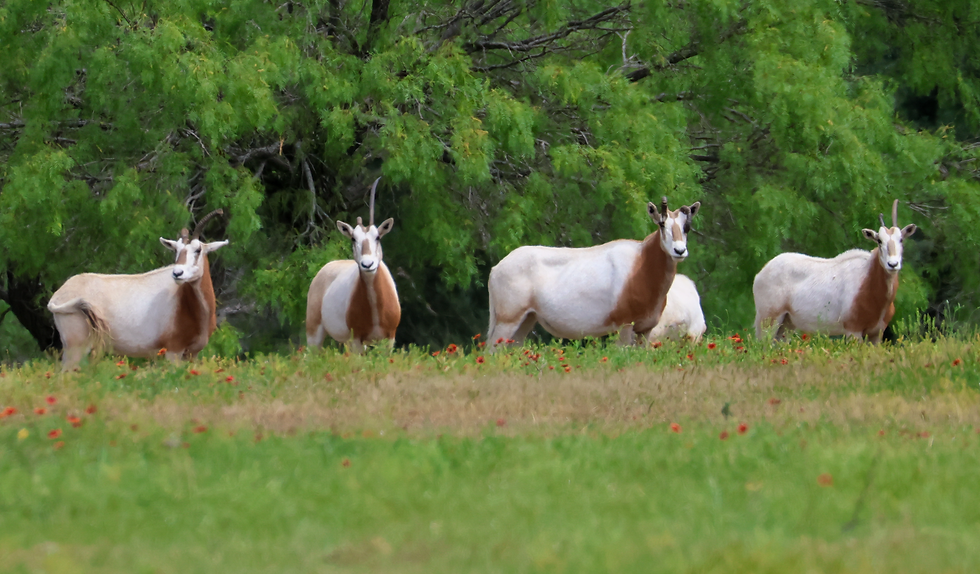
II. SCIMITAR ORYX
The Unicorn Antelope
One of John's favorite stories to share with young visitors begins with a question: "Do you know where the legend of the unicorn came from?" Looking at a scimitar oryx in profile, it's easy to imagine how early travelers might have believed they were seeing a horse-like creature with a single horn. Our herd occasionally produces an even more convincing "unicorn." Because the oryx roam freely through wooded areas, one sometimes breaks a horn while navigating the brush or sparring with another oryx.
Distinguished by its long, elegantly curved horns that mirror a scimitar sword, this striking white antelope with a rich chestnut chest was declared extinct in the wild in 2000. In the last 25 years, private ranches, conservation organizations, and wildlife sanctuaries have helped bring the species back from the brink of extinction. Today, an estimated 15,000 to 17,000 scimitar oryx live worldwide, and the species has been reclassified from extinct in the wild to endangered. Moved from extinct to endangered, scimitar oryx now number 15,000-17,000 worldwide.
Texas has the most scimitar oryx, holding an estimated 11,000-12,000 on private ranches, outnumbering the entire remaining population in their native African range.
In late 2022, our ranch acquired a tiny oryx herd--two males and three females. Four years and eight births later, the herd has grown to 13 thriving antelope. Guests regularly watch them graze just yards from the cabin, offering a rare opportunity to experience one of conservation's greatest success stories from your front porch.
BEST TIME TO SEE THEM:
Their peak activity is around dawn and dusk.
BEST PLACES TO SPOT THEM:
Bale grazing areas. It's often a toss-up whether they want to eat the hay or climb on its. Coastal field if the gate's open. Lower pasture, near the west river gate.


Describe your image
-
Native home:
The Sahara Desert of North Africa.
-
Lifespan:
Up to 20 years.
-
Physical Characteristics:
Adults are creamy white with distinct caramel markings; calves are born all-over caramel and begin turning within a few weeks.
-
Interesting to Know:
-
Aristole was one of the first scholars to cite the oryx as the origin of the mythical unicorn.
III. PÉRE DAVID (MILU) DEER
The World's Oddest Deer--"Four Not Alike"
Unlike the other deer on the ranch, Père David's deer seem perfectly at home in the water. During the heat of summer, it's common to find them wading into a pond or swimming from one bank to the other. Their unusually broad, slightly webbed hooves help them move through soft, muddy ground, making wetlands their natural habitat.
From Extinction to Texas
By the early 1900s, Père David's deer had disappeared from the wild. Today, every Milu alive anywhere in the world descends from a remarkably small group of survivors protected more than a century ago. Thanks to decades of careful conservation, the species is once again living in protected habitats—and on carefully managed ranches like ours. It's remarkable to think that visitors standing beside one of our ponds in Central Texas are watching an animal that very nearly vanished forever.
Water Is in Their Nature
Unlike any other deer on the ranch, Milu seek out water. On hot afternoons, you'll often find them standing belly-deep in one of the earthen ponds or swimming quietly from one bank to the other. Their ancestors evolved in marshes and floodplains, so water has always been part of their world. Their broad, slightly webbed hooves are perfectly adapted to standing belly-deep in a pond on a hot Texas afternoon.
Our Herd
We welcomed our first Père David's deer in 2023, and since then we've celebrated two healthy fawns. One of our favorite pastimes is watching this year's youngster and last year's fawn explore the ranch together. Because the worldwide population descended from so few founders, every healthy birth feels like a small victory—not just for our ranch, but for one of the world's most remarkable conservation stories.
These deer spend much of the day grazing or relaxing in one of the earthen ponds they've claimed as theirs. Especially in the summer, you'll find them enjoying what we jokingly call a "mud spa," contentedly standing or lying in the cool water while the Texas sun blazes overhead. Watching a mother with her fawn is one of the greatest pleasures of spring and early summer. Because the worldwide population descended from so few founders, every healthy calf represents another small victory for the future of this extraordinary species.
BEST TIME TO SEE THEM:
They're a bit unpredictable but spend more daylight hours openly grazing than some of the other species.
BEST PLACES TO SPOT THEM:
The earthen tank and grasst area just inside the Star Gate. The wooded area about 50 yards east of our fenced lodging.


-
Native home:
China.
-
Lifespan:
15 to 20 years.
-
Physical Characteristics:
Their coat is shaggy with somewhat long, curly hair. The color varies with seasons from red to grayish-brown. Their
antlers are thick and their 20-inch tail sports a black tassel.
-
Interesting to Know:
Because Père David's deer survived for centuries under human care in imperial parks and later on European estates, they
are often less wary of people than many deer species. Even so, they're still wild animals. If one calmly watches your
vehicle instead of running away, enjoy the moment—but give it the space and respect every wild animal deserves.
BLACKBUCK ANTELOPE
Built for Speed
Blackbuck are among the fastest animals on the ranch. When startled, they don't simply run—they explode into a series of graceful leaps that can carry them six feet into the air. Watching a herd bound across an open pasture is one of the most spectacular sights at Red Bluff Guest Ranch.
BEST TIME TO SEE THEM:
Morning and evening.
BEST PLACES TO SPOT THEM:
Open pastures, where they have room to graze—and run. Lower pasture near the gate to the river. Coastal field if open.


-
Native home:
India, Nepal, and Pakistan
-
Lifespan:
10 to 15 years.
-
Physical Characteristics:
Females and immature blackbuck are a sleek tan with white bellies; mature males transition into a dramatic, high-
contrast jet-black coat with striking spiral horns that look straight out of a fantasy novel.
-
Interesting to know:
Blackbucks are among the fastest land mammals on Earth, capable of sustaining speeds of 50 mph.
AXIS DEER
The Deer in Polka Dots
If you're familiar with the Texas Hill Country, you've probably seen axis deer before. Their chestnut coats covered with bright white spots make them one of the easiest deer to recognize—and unlike white-tailed deer, they keep those spots for life.
Our axis are usually a little more cautious than the fallow deer. They often graze quietly along wooded edges before slipping back into the trees, so a slow walk is your best chance to spot them.
BEST TIME TO SEE THEM:
Early morning and evening.
BEST PLACES TO SPOT THEM:
Along wooded trails and in shaded pastures.


-
Native home:
India, Nepal, Sri Lanka
-
Lifespan:
18-22 years
-
How to recognize them:
Orange-red coat, permanent white spots, and three-pronged antlers on males
-
Interesting to know:
Because axis deer don't have a single breeding season, you may see spotted fawns, velvet-covered antlers, and hard antlers all at the same time of year.
CLASSIC (CCARA) LLAMAS
The Gentle Icons with a Quirky Side
If you’ve visited a ranch or farm before, you’ve likely been charmed by a llama's long neck, banana-shaped ears, and intensely expressive eyes. They are highly social herd animals with an intelligent, inquisitive nature that makes them excellent livestock guardians and exceptional companions.
While they are famous for their dramatic spitting, this is actually a sophisticated form of communication reserved almost entirely for settling arguments within their herd. They are typically gentle and calm around humans, choosing to reserve their dramatic warning signs—like pinning their ears completely flat or lifting their chins high—for moments when they feel deeply threatened. When they aren't keeping a watchful eye on the pasture, these gentle eccentrics love to indulge their sweet tooth, going absolutely wild for crunchy treats like fresh carrots and sliced apples.
BEST TIME TO SEE THEM:
Throughout the day, especially during morning and late afternoon feeding times. BEST PLACES TO WATCH THEM:
Grazing in open pastures or keeping watch near smaller livestock groups

-
Native home:
The high Andes Mountains of South America (primarily Peru, Bolivia, and Chile)
-
Lifespan:
15–20 years (sometimes up to 25 years with excellent ranch care)
-
How to recognize them:
Standing 5.5 to 6 feet tall, they sport a thick, hypoallergenic double coat that comes in a massive variety of colors—including
solid white, black, brown, gray, beige, and striking multi-color or spotted patterns.
-
Interesting to know:
Those big, beautiful eyes actually protrude slightly to give them a panoramic view of their surroundings. This allows them to
spot potential danger from almost any angle to keep the whole herd safe.
Natives
WHITE-TAILED DEER
I'm a paragraph. Click here to add your own text and edit me. It's easy.'
BEST TIME TO SEE THEM:
BEST PLACES TO WATCH THEM:

Native home:
Lifespan:
How to recognize them:
Interesting to know:
SMALL MAMMALS
BEST TIME TO SEE THEM:
BEST PLACES TO WATCH THEM:


